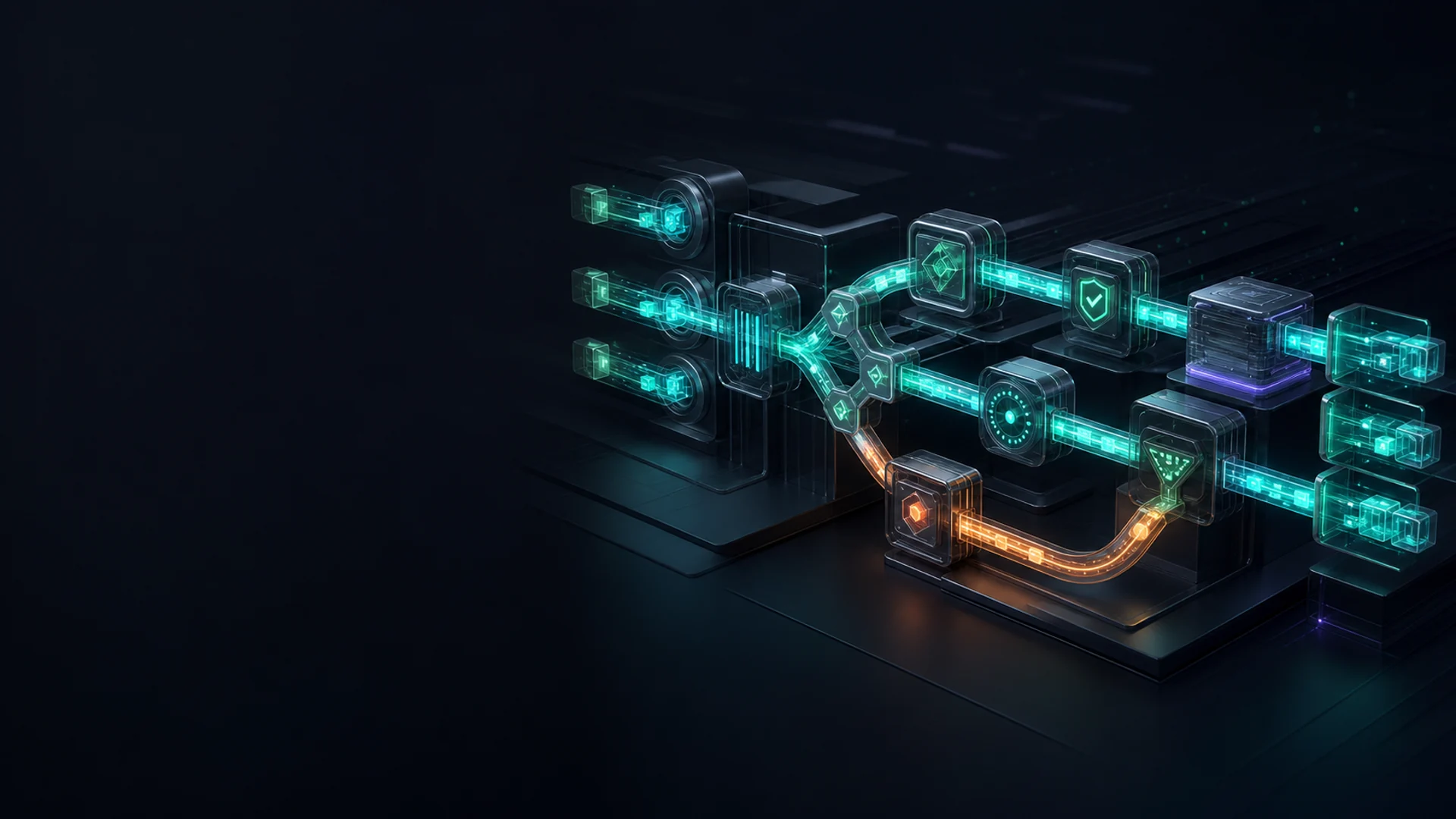
Process before toolsExceptions without dead endsComplete execution trace
Operational Flow Studio
Choose one repetitive task
Select a common scenario and explore the shape of the future flow.
The states shown here illustrate design targets, not guaranteed outcomes. Real measures are set after observing the process and establishing a baseline.
01 / INTELLIGENT INTAKE
Fragmented inputs become one actionable case.
Email, forms, and documents are received; required information is extracted and validated; then a case is created with a clear owner, priority, and response target.
ReceiveExtractValidateCreate & Route
02 / GOVERNED APPROVAL
Approvals leave chat threads and individual memory.
Requests follow the right path based on value, type, team, or risk. Reminders and delegates activate automatically, and everyone can see where work stands.
RequestRouting RulesOwner ApprovalRecord Outcome
03 / SYSTEM SYNCHRONIZATION
Data is entered once and moves where it belongs.
An event in the source system activates the flow. Transformation and quality checks run before destination systems update without manual copying.
EventTransformControlSynchronize
04 / CONNECTED SERVICE FLOW
A customer request remains traceable from first message to outcome.
Information is collected, the topic is classified, an SLA starts, and work reaches the right team. The customer receives a reliable status along the way.
Customer MessageClassifyRoute & SLANotify
Building Blocks of a Reliable Flow
Work that can be automated
A durable flow understands inputs, executes policy, connects tools, and keeps the state of every run visible.
01 / CAPTURE
Multichannel Intake
Forms, email, files, messages, and system events enter one controlled point.
02 / DOCUMENT
Document Processing
Extract and validate information from PDFs, images, contracts, and invoices.
03 / DECIDE
Rules & Routing
Conditions, priority, risk, authority limits, and branching paths.
04 / CONNECT
API & Event Integration
Secure coordination across CRM, ERP, websites, and internal services.
05 / APPROVE
Approvals & SLA
Owner queues, delegates, reminders, escalation, and complete decision timing.
06 / INFORM
Automated Communication
Contextual status messages for customers, specialists, and leaders.
07 / REPORT
Live Monitoring & Reporting
Volume, cycle time, delay, error, and team capacity visible in real time.
08 / RECOVER
Error & Exception Handling
Retries, recovery queues, and human escalation keep work from disappearing.
The Simplest Reliable Technology
AI is not always required
The best automation uses the lowest-risk layer that solves the full problem. Several approaches may coexist in one flow, but complexity needs an operational reason.
Rules & Workflow
For stable processes with clear conditions, roles, approvals, and outcomes.
01
API & Event Automation
For durable system connections and immediate action after a state change.
02
Interface & Legacy Automation
When a system has no API and controlled interface automation is necessary.
03
AI-assisted Automation
For text and document understanding, classification, extraction, and contextual work.
04
Operations Control Center
Handle errors and stops
The happy path is only part of the design. We define where errors are recorded, who sees exceptions, how retries behave, and how work continues without silently disappearing.
Observable by design
Human Exception Queue
Ambiguous or sensitive cases reach an accountable person with full context.
Alerts & Recovery
Connection failures, delays, and SLA breaches have explicit recovery paths.
Auditable History
Inputs, executed rules, state changes, and decision actors are recorded.
Secure Access & Secrets
Tokens, service accounts, and action scopes follow least-privilege controls.
Measurable Improvement, Not a Technology Demo
How we deliver automation
Automating a weak process only accelerates error. We clarify the route and exceptions before building the smallest pilot that delivers one real outcome end to end.
Observe & Establish the Baseline
Time, volume, error, roles, tools, and current success measures
01
Redesign the Flow Map
Remove waste and define rules, exceptions, and responsibility boundaries
02
Pilot One Complete Flow
Run from input to outcome with representative data and real users
03
Integrate & Deploy Safely
Systems, access, alerts, training, and a rollback plan
04
Measure & Expand
Compare against baseline, remove bottlenecks, and add the next flows
05
MAP THE WORK. DESIGN THE FLOW. MEASURE THE CHANGE.
What task repeats every day?
Describe one manual process, the tools involved, and the current bottleneck. We will assess automation fit, complexity, and a credible pilot starting point.